RiverGen Decision Intelligence Implementation (1.0.2)
Page Outline
Execution Design Pattern
The RiverGen Decision Intelligence Agent (DIA) is implemented as a high-performance orchestration core using FastAPI and Apache Kafka. It follows the ML-Refinement Pattern, where raw machine learning predictions are hardened by platform-specific governance logic before execution.
This implementation (v1.0.2) ensures that the platform doesn't just act on "probability," but on "validated intelligence."
RiverGen Core Service Architecture
The DIA interacts with the entire RiverGen ecosystem through a specialized sidecar architecture:
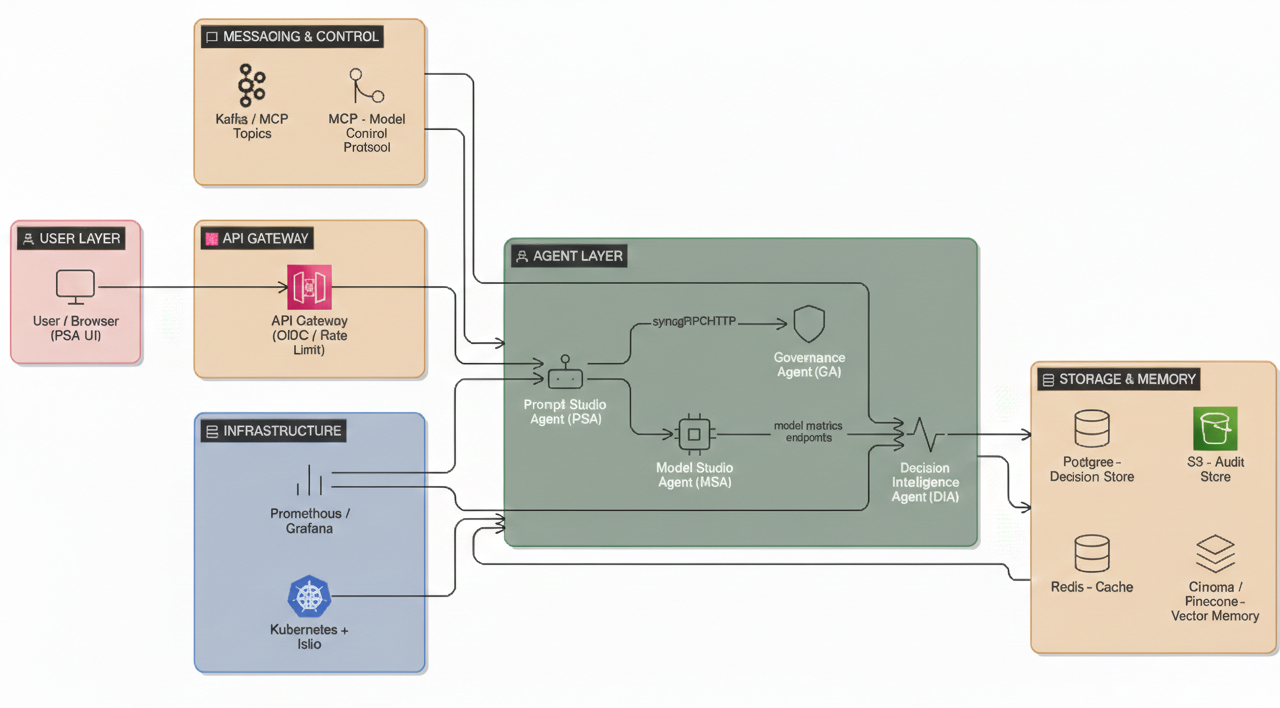
View Mermaid Source Code
The Triple-Phase Decision Pipeline
Phase 1: Multi-Agent Feature Synthesis
Raw logs from various RiverGen agents (JSON/Parquet) are converted into unified feature vectors.
- Dimensionality Alignment: Mapping disparate agent states into a standardized latent space.
- Drift Scoring: Real-time comparison of incoming telemetry against the 1.0.2 baseline.
- Fast Isolation: Non-critical noise is filtered out before reaching the ML engine to preserve compute.
Phase 2: ML Inference Engine (1.0.2)
This service executes the models produced by Model Studio.
- Hot-Loading: Models are held in the Redis Intelligence Layer for sub-10ms access.
- Adaptive Fallback: If a specialized model (e.g.,
river_flow_v2) fails, the engine falls back to the robustrg-global-baseline-102model. - Inference Sharding: Decisions are categorized by intent (Governance, Performance, Security) and routed to specialized inference workers.
Phase 3: Logic Refinement & Governance
The final layer where ML output is cross-referenced with the project's operational boundaries.
- Guideline Hot-Reload: Policy changes made in the Governance Agent (GA) are reflected in DIA without a service restart.
- Deterministic Overrides: Hard limits (e.g., "Never exceed 90% CPU") take precedence over ML-suggested optimizations.
Event-Driven Data Mesh
DIA 1.0.2 utilizes a strictly governed messaging schema:
| Topic Name | Purpose in RiverGen |
|---|---|
rg.telemetry.inbound | High-velocity metrics from all active generators and agents. |
rg.model.registry.events | Invalidation signals when Model Studio publishes a new 1.0.2 artifact. |
rg.decision.outbound | Command signals dispatched to autonomous agents for correction. |
Platform Scalability & Fault Tolerance
- State Isolation: DIA is stateless, allowing for horizontal scaling across Kubernetes nodes.
- Circuit Breaking: If latency in metadata aggregation exceeds 100ms, the system enters "Safe Mode," defaulting to last-known-good policies.
- Graceful Degradation: If the ML engine is unresponsive, the system continues to operate using purely deterministic guidelines.
Security & Audit Trails
Every decision made by DIA 1.0.2 is recorded in the RiverGen Audit Ledger:
- Inputs: Hash of the feature vector and agent source.
- Model: Specific version and ID of the model used.
- Output: The raw prediction and the final refined command.
- Reasoning: Natural language string generated by the Refinement Layer.
Technical Implementation - RiverGen Core - Version 1.0.2